 Hyperliquid
Hyperliquid HLP profit sharing, liquidation exposure and withdrawals
Hyperliquid HLP lets depositors share market-making and liquidation profit and loss through a community-funded protocol vault. HLP stands for Hyperliquidity Provider. Its results also include allocated trading fees and USDC lending through Earn. Depositor equity changes with the vault's performance, including periods of loss.
· last updated
Pooled HLP exposure and self-directed market making
An HLP deposit shares pooled strategy results; running your own market-making orders gives you control over individual quotes and positions. Market making means providing buy and sell quotes on an order book. Filled orders can open, increase, reduce or close positions. Any remaining inventory, or market exposure, persists until the strategy offsets or closes it. A quote can remain unfilled, fill partially or build exposure as other orders trade against it. HLP puts the vault's combined results behind each depositor's share, without requiring that depositor to manage the quotes.
Direct market making requires managing quotes, position exposure and the margin that supports them. HLP participation follows the pooled strategy and its withdrawal restrictions. Depositing therefore commits capital to different conditions from funds that remain available in an account. The depositor's account records vault equity, while the underlying trading exposure belongs to the vault.
Trading results, fee income and Earn supply
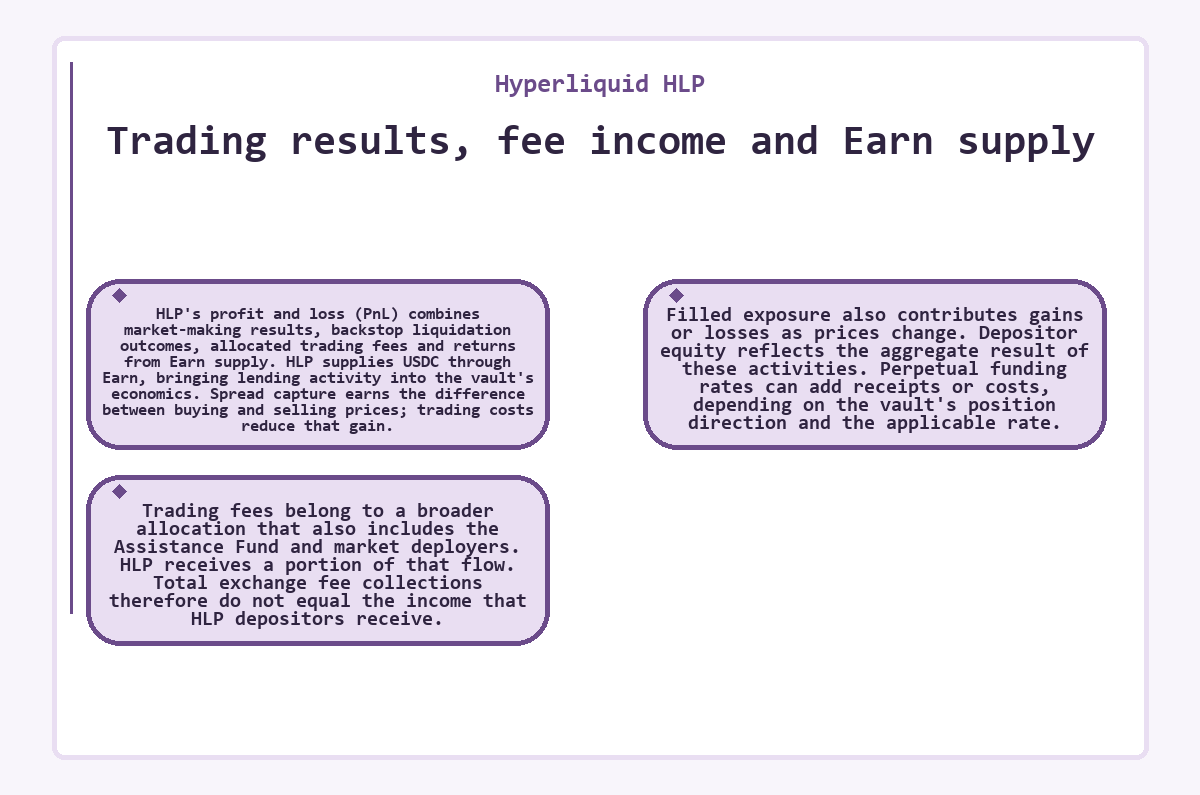
HLP's profit and loss (PnL) combines market-making results, backstop liquidation outcomes, allocated trading fees and returns from Earn supply. HLP supplies USDC through Earn, bringing lending activity into the vault's economics. Spread capture earns the difference between buying and selling prices; trading costs reduce that gain. Filled exposure also contributes gains or losses as prices change. Depositor equity reflects the aggregate result of these activities.
Perpetual funding rates can add receipts or costs, depending on the vault's position direction and the applicable rate.
Trading fees belong to a broader allocation that also includes the Assistance Fund and market deployers. HLP receives a portion of that flow. Total exchange fee collections therefore do not equal the income that HLP depositors receive.
Backstop liquidations and the exposure HLP inherits
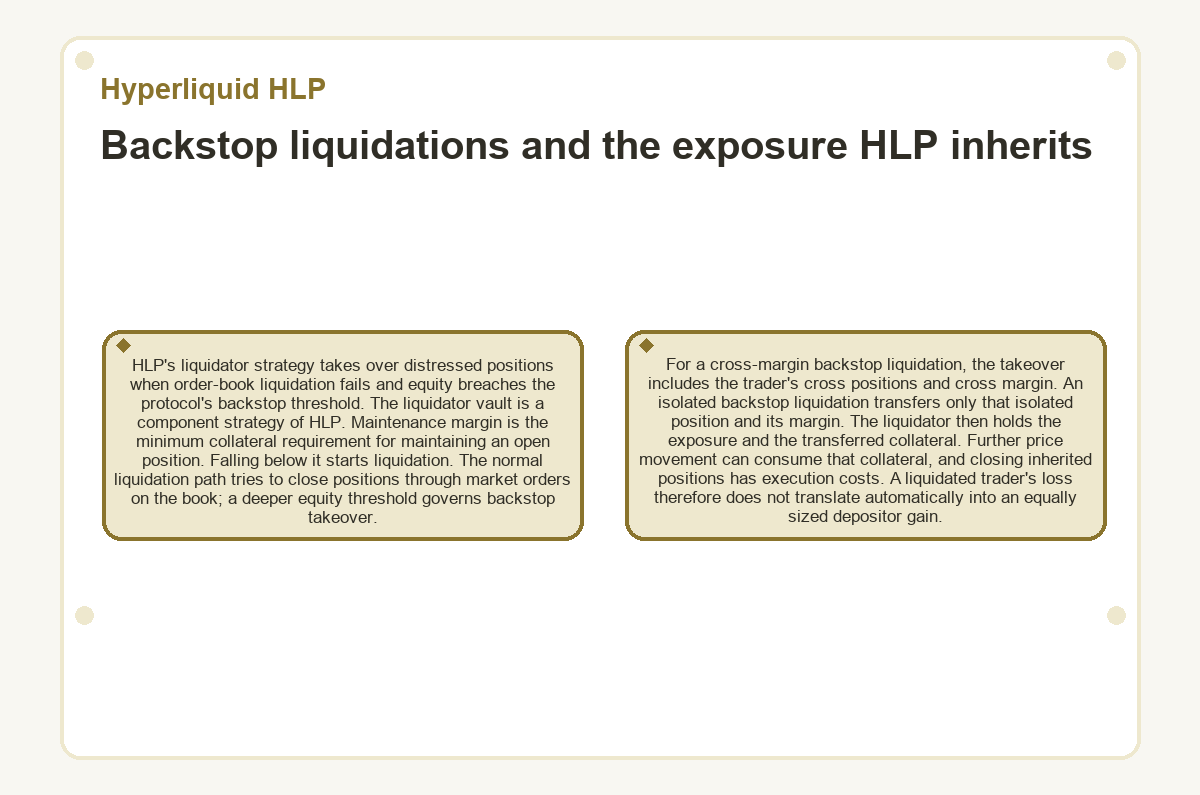
HLP's liquidator strategy takes over distressed positions when order-book liquidation fails and equity breaches the protocol's backstop threshold. The liquidator vault is a component strategy of HLP. Maintenance margin is the minimum collateral requirement for maintaining an open position. Falling below it starts liquidation. The normal liquidation path tries to close positions through market orders on the book; a deeper equity threshold governs backstop takeover.
For a cross-margin backstop liquidation, the takeover includes the trader's cross positions and cross margin. An isolated backstop liquidation transfers only that isolated position and its margin. The liquidator then holds the exposure and the transferred collateral. Further price movement can consume that collateral, and closing inherited positions has execution costs. A liquidated trader's loss therefore does not translate automatically into an equally sized depositor gain.
Vault equity, personal returns and measurement windows
Depositor performance follows the return on the capital actually invested, so vault size alone cannot establish an individual's profit. Total value locked measures the value of capital held in the vault. New deposits can increase that total without profitable trading. Withdrawals can reduce it during a profitable period. The vault's PnL record and its capital flows answer different questions, which makes a balance change an incomplete measure of return.
Your entry time determines when your capital begins sharing the vault's subsequent performance.
An annualized figure expresses performance from a measurement window on a yearly basis. A short strong period can produce a large annualized number without a full year of outcomes. The window and treatment of cash flows affect how that number should be read. Your own performance record concerns your participation, while lifetime vault history includes periods before you deposited. Comparing matching intervals avoids treating different holding periods as equivalent.
Unrealized PnL reflects value changes in positions that remain open, using the mark price for perpetuals. Mark price is the protocol's valuation price for margin and liquidation calculations. Profitable completed trades can coexist with losses on the vault's open book. Those outstanding losses affect the equity behind depositor shares before the positions close.
Confirming an HLP deposit before adding more capital
A confirmed deposit needs both a processed vault-deposit record and HLP equity associated with the depositing account. If further action requires certainty about exposure, keep the next deposit on hold until those records agree. The native vault action identifies the destination vault and whether funds are entering or leaving it.
| Deposit stage | Action or condition | Record to inspect | Balance scope |
|---|---|---|---|
| Funds available | Confirm HLP permits deposits and funds are available | Account balance and deposit permission | USDC available for the vault deposit |
| Deposit authorized | Sign and submit the selected HLP deposit | Destination vault, amount and deposit direction | Capital designated for HLP |
| Deposit recorded | Check the processed vault deposit | Ledger entry naming HLP and the deposited USDC | Contribution received by the vault |
| Vault share reconciled | Read equity and the deposit lock for the same account | Depositor equity and updated unlock timestamp | Recorded share of pooled HLP equity |
Signing authorizes the deposit; the processed ledger entry records its effect. The depositor record links the vault exposure to the account that supplied capital. Strategy PnL may already have changed the equity by the time it appears, so equity need not equal the transfer amount. A missing or contradictory record leaves the deposit unresolved before any additional commitment.
When can an HLP deposit be withdrawn?
An HLP deposit becomes eligible for withdrawal after its lock expires, with the timing measured from the most recent deposit. An additional deposit resets withdrawal timing for the account's HLP balance. The depositor's unlock timestamp identifies when the timing restriction ends; the protocol controls the lock duration. That timestamp establishes timing eligibility, while the amount available to withdraw from HLP sets a separate limit. A total equity figure does not establish how much a withdrawal can release.
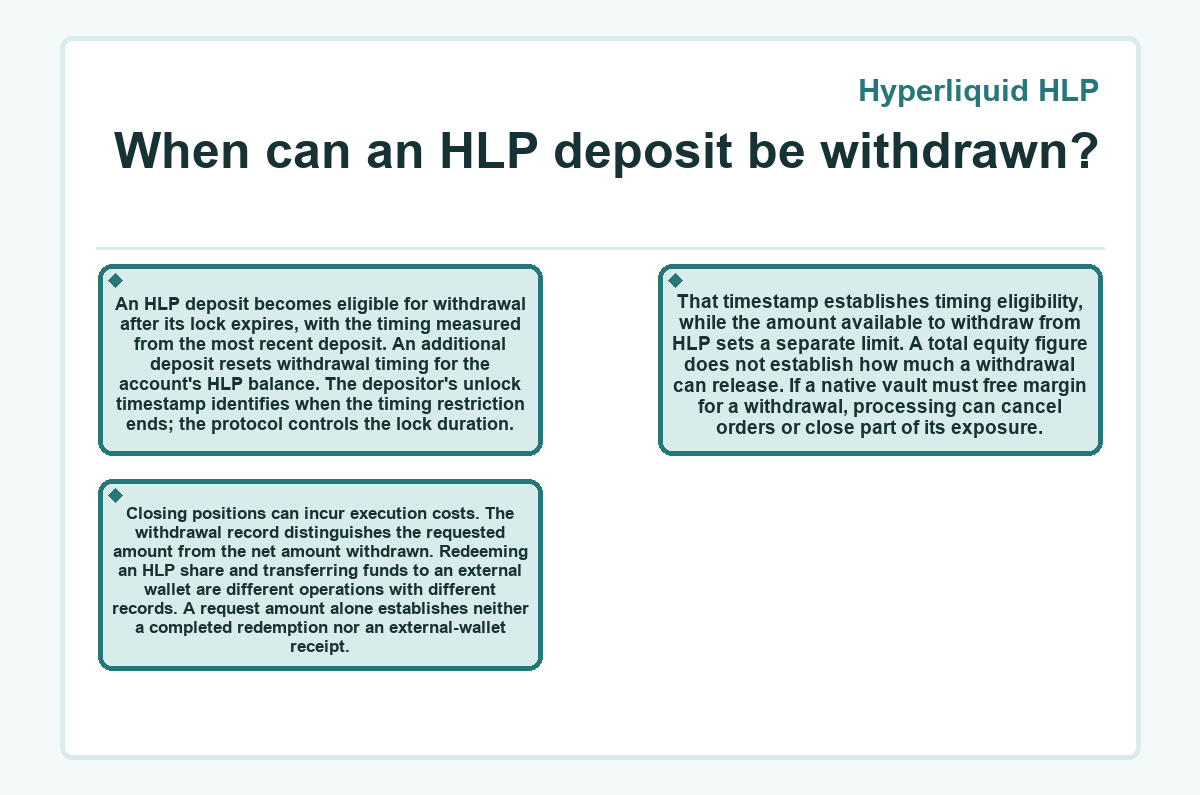
If a native vault must free margin for a withdrawal, processing can cancel orders or close part of its exposure. Closing positions can incur execution costs. The withdrawal record distinguishes the requested amount from the net amount withdrawn. Redeeming an HLP share and transferring funds to an external wallet are different operations with different records. A request amount alone establishes neither a completed redemption nor an external-wallet receipt.
Losses that fee income cannot offset
Trading losses can exceed HLP's spread capture, allocated fees and lending income, reducing the equity that backs depositor shares. Quoting both sides of a market does not keep actual fills balanced. Unequal fills leave directional exposure, meaning gains and losses depend on the direction that prices move. Different positions can also lose value together during a broader market move. Depositing USDC does not remove the trading risk in the vault's positions.
Position exposure relative to vault equity helps explain the sensitivity to price changes. A larger pool of capital alone does not establish lower risk. Historical drawdown describes losses during its observation window, while the vault's positions can change afterward. Once a deposit unlocks, its exposure continues until an actual withdrawal reduces the recorded share.
Good to know
-
Does depositing in HLP count toward my personal trading-volume fee tier?
- An HLP deposit does not add the vault's trading volume to your personal fee-tier calculation. Hyperliquid treats vault volume separately from the master account's volume. Any discount that your account receives follows its applicable fee rules, separately from your share of HLP's results.
-
Is HLP subject to a vault leader's profit-sharing commission?
- Protocol vaults such as HLP do not charge a vault leader's profit share. Trader-managed legacy vaults have a different profit-sharing arrangement that compensates the leader. The exemption concerns the vault-level commission, so it does not remove the strategy's trading costs. Funding payments and costs incurred when positions close can still affect the economics of an HLP deposit.
-
Can my HLP contribution stay invested if I stop placing personal trades?
- An HLP contribution remains invested independently of orders in your personal trading account. It shares the strategy's results while the deposit remains in an active vault. Personal trading inactivity does not close the vault's positions or turn deposited capital into an available account balance. The vault's operations determine its PnL, while your deposit record identifies the share that belongs to you.
-
What distinguishes an HLP deposit from staking HYPE?
- An HLP deposit shares liquidity-strategy profit and loss, while staking HYPE delegates tokens to validators. Validators participate in block production and receive staking rewards under separate rules. These mechanisms use different account records and create different exposures. Owning or staking HYPE does not establish an HLP deposit, and a vault return should not be read as a validator reward.
-
Are HLP depositor addresses and balances public?
- Vault information is publicly queryable and can include depositor addresses, equity and deposit timing. An address can become associated with a person if someone links it to an identity elsewhere. Hiding an address in a browser does not change the public vault record. Signing keys remain separate from the account information that others can read.
-
Will a tokenized vault product follow native HLP withdrawal rules?
- A tokenized product follows its own contract terms, so the native HLP lock does not establish that product's redemption rules. HyperEVM builders can create vaults with customized accounting. If a product represents HLP exposure, its token balance differs from a direct deposit record in the protocol vault. The additional contract layer may introduce its own expenses or restrictions.
-
Why can a portfolio graph miss a short-lived change in HLP equity?
- Portfolio graphs use sampled account values, so movements between samples may not appear at their full size. Account value includes vault balances, which makes that limitation relevant to HLP. A plotted line can help review a trend. Exact accounting requires account state and ledger events for the period in question.